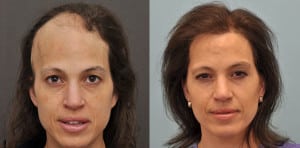
Patient CB – 37 year old female, was diagnosed with a brain tumor and required chemotherapy treatment. Although the treatment was successful she was left with significant permanent hair loss more than 4 years later.
She is an artist, musician/singer and was referred to Dr. McGrath by a friend. In her consult form she wrote in that she felt “ugly, ugly” Hate always wearing scarves and wigs. Her first transplant procedure was in April 2011. Her follow up photos were taken immediately post op and 8 months later.
This patient, now age 25, was diagnosed with a very rare cancer called Pilomatrical Carcinosaroma in Dec. 2008. He underwent surgery several times that left scars on the left side of his head and face. His rehab consisted of several weeks of high dose radiation and chemotherapy that resulted in loss of hair on the left side and back of his head that would never grow back. He came to Dr. McGrath to replace the permanently damaged hair follicles and to cover the scars. Dr. McGrath performed a single session of 2541 grafts on him on July 25, 2011. After Results are from 8 months post-op.
This restoration procedure was performed Pro Bono as part of Operation Restore a program sponsored by the International Society of Hair Restoration Surgeons.
When the loss of hair occurs because of disease or trauma the factors associated with such a hair loss process may produce particularly profound effect. Recognizing that many of these people in the process of physical and emotional recovery may lack the resources for corrective hair restoration surgery, the ISHRS Pro Bono Foundation was formed.
This program matches prospective hair loss patients with volunteer ISHRS physicians to obtain hair restoration services to help restore the physical and emotional wellness of the individual. The foundation provides financial, travel, lodging, and medical assistance to eligible patients.
The following is a transcript of the video at the bottom of this page of Dr. McGrath discussing Histogen.
I’d like to talk about some very exciting news about the development of a new product out there that may well revolutionize hair restoration surgery or hair thinning and balding as we know it. This is a complex topic, but the name of the compound is called HSC. Maybe some of you have heard about it, maybe not, but if this is new to you, HSC stands for Hair Stimulating Complex and what it is basically is a combined mixture. It’s a liquid composition that’s meant for injectable, direct injectable use into the scalp. It’s basically been developed by growing newborn cells in an embryonic condition and bathing them with specific types of stimulating proteins, in particular a protein called Wnt, in fact, it’s Wnt7a, a very specific type of growth stimulating protein as well as a chemical compound known as follistatin.
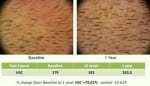
Apparently, the company has found in their investigations when this is bathed in this complex at a very low oxygen level, they’re able to really maximize the effects of this compound, and the phase studies that have been done through phase I clinical trials had been really nothing short of remarkable. At the end of one year, the first trial, they found a 73% increase in the growth of hair from baseline. Now that’s amazing. That’s an amazing finding and it’s revolutionary. If this ends up being something that can be used broadly in the markets, it could totally change hair loss as we know with men and women potentially.
So again, the name of the complex is HSC. It’s made by a company called Histogen. Now Histogen has been around since early 2007 and they’re really a cutting edge company that’s developing some amazing new products not just for hair loss, but for other types of stem cell research and tissue regeneration, amazing stuff that they’re doing. I know they have topnotch investigators involved in this. My mentor is involved as one of the lead investigators with this compound, HSC, so I know they have some amazing people involved with this.
So I want to get some information to the basic public about it. It’s something to keep your eye on. There’s a lot of technical complicated reports about it online, but I wanted to try to break it down for you. It’s not available in the States yet and probably won’t be until the very earliest 2014, 2015 maybe. It depends on how things go in some of other where it’s being studied in Asia and other select countries, but it’s an amazing product that I think could revolutionize what we do and I think it’s something that you all want to know about firsthand.
So that’s what’s called, HSC. Do some research on it. If you have any other questions, log on to the site, drop them off. I’ll be happy to address them individually and see, you know, if I can help you get your answers that you’re looking for.
Watch the first-hand account of a recent hair transplant patient who describes the hair transplant procedure by Dr. McGrath and how it has affected his life.
In recent years there has been a tremendous amount of buzz in the hair transplant industry about a procedure known as Follicular Unit Extraction. Commonly referred to as FUE, this is the process of removal of the donor hair that is to be used for the transplant process, literally one graft at a time. The process has gained popularity for several reasons, not the least being the fear that many patients have of the strip excision for harvesting donor hair. Despite the fact that strip excision is the gold standard for the procedure many patients are fearful of potential scarring.
It is very important to understand exactly what the difference is between the two procedures. With any hair transplant procedure you must harvest hair from the donor area in the back of the scalp. How you harvest this hair is the only difference between an FUE vs Strip Excision procedure. The rest of the transplant process and results are exactly the same. In the FUE process a very specialized tool is used to extract the grafts and the tool that is used is completely up to the surgeon and his or her personal preference. There are several devises on the market that work very well, I for one use both Neograft and a device called the Safescribe Motorized FUE Extractor.
Now why does any of this matter? Why am I going on about boring details of types of surgical instruments and different types of harvest methods for hair transplantation?
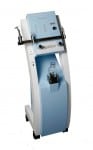
Well enter Neograft which is a machine that is used to perform the extraction process for an FUE procedure, but if you were to perform an internet search on Neograft you would be led to believe that it is a evolutionary new automated procedure for hair transplant surgery.
The Neograft machine has been aggressively marketed to many physician practices across the country with the promise of an easy and profitable method for the non hair transplant trained physician who are trying to increase their bottom line, but yet don’t have the surgical hair restoration experience and training or the know how to put together a successful hair transplant practice.
As an experienced hair restoration surgeon who has performed a full one year fellowship in hair restoration surgery and is certified by the American Board of Hair Restoration Surgeons I am aware of all the detailed skills that goes into a good hair transplant procedure. These are skills that are not acquired in a weekend course, Quality hair restoration comes from an experienced team and that team should have an experienced physician leader.
Hair transplantation is a relatively easy but highly work intensive procedure that requires a surgeon with good surgical and aesthetic skills. Each patient is different and brings special needs and cosmetic goals. This is not a procedure that you want performed by an inexperienced team of surgeon and technicians.
The Neograft machine in the proper hands is a wonderful tool but in the wrong hands it is a bad hair transplant waiting to happen. FUE hair transplantation has increased in popularity and the Neograft machine in my hands provides an efficient and cost effective method for FUE harvesting. It is not the machine though but rather the physicians skill level that will assure you the excellent results you deserve.